About halfway through my summer, a summer which I believe most of us will agree has been nothing like past summers, I received a phone call that simultaneously made the teacher in me cry (silent, dramatic tears) and the book-a-holic in me dance a celebratory jig. My high school needed a new English elective to replace one in which students were showing little interest. I was being asked to develop the course and write the curriculum. It needed to be ready for the Board of Education’s review in three weeks.
😭 Crying…this was no small task. This was a LOT of work for three weeks. My youngest daughter was going off to college and I wanted to spend that time with her. Saying no wasn’t really an option. (Life needs to stop it already with these choices that aren’t really choices.)
💃Dancing… (Not real dancing. I’m still recovering from a bad car accident and my walking would more accurately be described as hobbling) because to do this job right, I needed to read, read, read, read. A bibliophile’s dream.
So, I said “Yes” (You’re shocked, I know…) and began talking through my ideas for an elective that would be both engaging and relevant to our students. The winning suggestion was a course on Young Adult Literature.
Task #1: figure out what “a course on Young Adult Literature” means and write a course description.
While that seems simple, “Young Adult Literature” = books written for young adults, it is not quite that straightforward. (The bigger question is what constitutes a young adult?) You’d be surprised, (Or maybe not. I shouldn’t assume. My dad always warned me about what happens when we do.) to learn that the term “YA Literature” covers a very wide age range with extremely varied topics, some more geared for middle school-aged children and others for college-aged “new adults”. Choosing texts that students would find to be childish would be just as problematic as choosing books that parents believed were too adult. Both were complications that I aimed to avoid.
As far as a course description goes, here’s what I came up with:
The Voices of Young Adult Literature is a course in which students will read, examine, discuss, and write about literature typically categorized as Young Adult. The contemporary texts selected for this class will be diverse in authorship, protagonists, themes, and genres, with specific attention given to the voices of those who have, in the course of history and general English classrooms, been marginalized or ignored.
***The books we read in this course are meant to be interesting, culturally relevant, and thought-provoking.
The texts chosen for this course should comply with the following goals.
- Are written in language/style perfectly suited for the author’s purpose.
- Expose readers to complex human dilemmas
- Include compelling, disconcerting characters.
- Explore universal themes and themes of contemporary significance.
- Challenge readers to re-examine their understanding of the world.
- Tell a good story.
(**Full disclosure: The above criteria is credited to Classics in the Classroom (2004) by Carol Jago and was accessed via Teaching YA Lit Through Differentiated Instruction (2010) by Susan L. Groenke and Lisa Scherff)
Task #1: ✅
Task #2: compile a list of books to review.
This part was like playing a version of Who Wants to Be a Millionaire? I definitely used some of my lifelines.
- I polled the audience: I reviewed lists of young adult book award winners and finalists from the last few years. I Googled phrases like “best new YA books,” “YA Lit must-reads,” and “We need diverse books.” I read reviews on Goodreads and CommonSenseMedia. I went back through the notes from the graduate class I took in Young Adult Literature to see what books my classmates had recommended.
- I phoned a friend: (Actually, I emailed a colleague, but for all intents and purposes it’s the same thing.) This colleague, a middle school ELA teacher, reads a LOT of YA, so I knew she’d have some great recommendations. P.S. She did.
Task #2 ✅
With my list compiled I was ready for the next step.
Task #3: Read the books.
That couldn’t be done without the actual books. The public library wasn’t an option. Most of the titles were very current, were on the new release shelf with restricted lending, or were in high demand with waiting lists. Plus, I like to annotate my books if they are being used for instruction. (FYI. The library doesn’t like it when you annotate their books.)
My only option was to buy them. So, I spent over $200 on Amazon. (Sorry small book store owners, usually I’m right there with ya, but I really needed the books ASAP. I’ll do better next time.) And started to read.
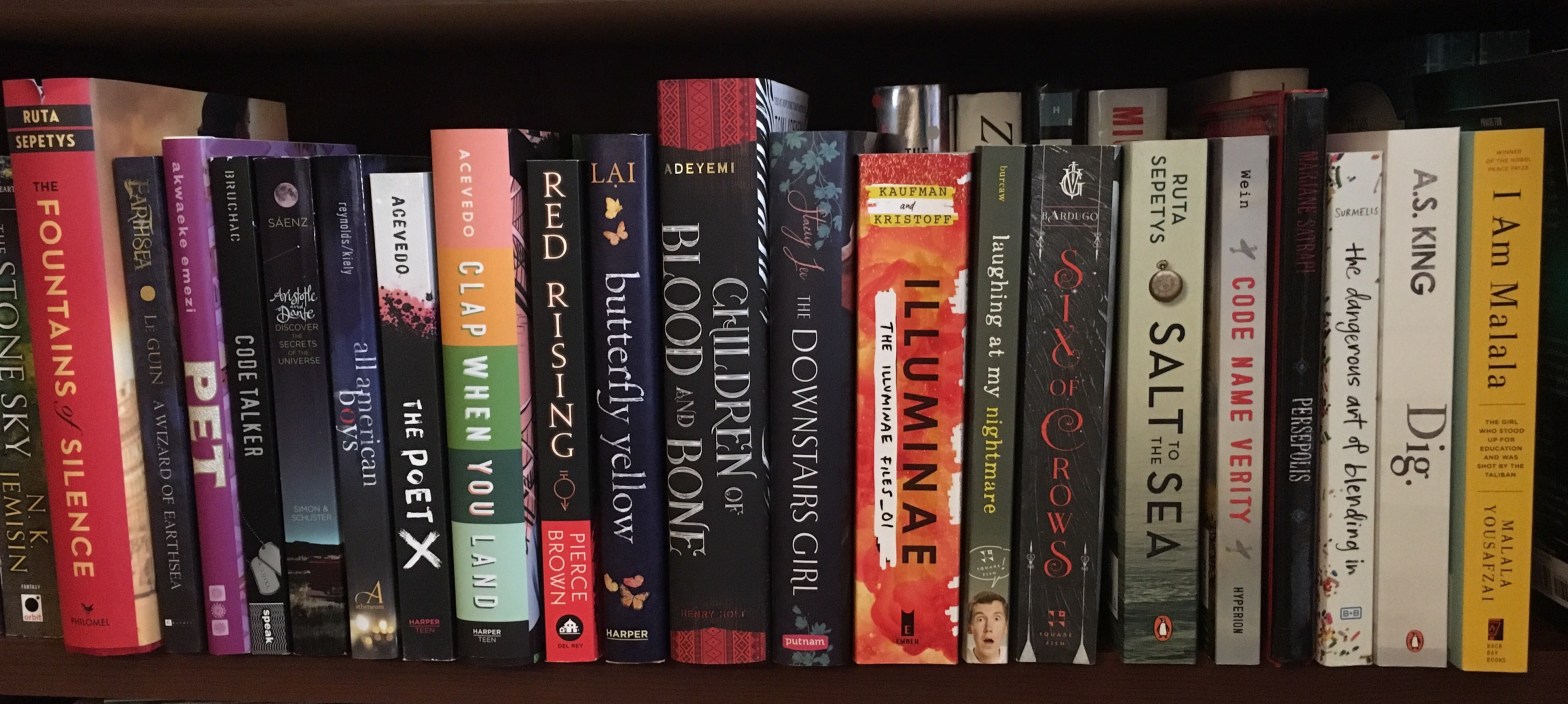
Here’s what I read:

I know what you’re thinking: She didn’t really read all of those books, right? Hello! Bibliophile…remember. YES. I. DID. And it was a glorious few weeks.
Task #3: ✅
As I read an average of a book a day, I began to formulate ideas for the course, ultimately deciding on a genre study. YA as the umbrella genre with subgenres: memoir, realistic fiction, sci-fi/fantasy, and historical fiction.
At this point, I could continue to explain my vision for the course, how I plan to use the subgenres to structure inquiry, what, ultimately students will do after reading these books, etc, but this blog is about books and I want to tell you about the ones that made the cut for this class (and a couple of the ones that didn’t but still deserve mention.)
Task #4: Choose books that best meet the goals of the class. (Scroll up and review what those goals were if you’ve forgotten 😉)
This was by far the hardest part. I found the majority of these books to be very well written. Some made my blood boil, some made my pulse race, some made me laugh, some made me want to cry. All of them made me think.
Whittling down the list to three titles per unit was challenging. I made a chart and kept track of key elements such as gender/race/ethnicity of the author, gender/race/ethnicity of the protagonist(s), format (graphic/prose/verse), setting, themes, representation of languages other than English, possible triggers, and interdisciplinary connections. It was very important to me to ensure that the voices that students heard through the texts studied in this course would be as diverse as our world.
After very careful consideration, and a lot of revising, here is the list of titles that will be the backbone of this new course. The ⭐indicates my personal favorites.
Unit 1 – The Memoir
Persepolis, by Marjane Satrapi
Laughing at my Nightmare, by Shane Burcaw ⭐
I am Malala, by Malala Yousafzai
⭐ = Burcaw is raw, real, and truly inspirational.
Unit 2 – Sci-fi / Fantasy Fiction
Red Rising, by Pierce Brown
Children of Blood and Bone, by Tomi Adeyemi ⭐
Illuminae: The Illuminae Files 01, by Amie Kaufman and Jay Kristoff
⭐ = Adeyemi creates an engaging fantastical world that mirrors the horrors of our current reality.
Unit 3 – Realistic Fiction
Poet X, by Elizabeth Acevedo
All American Boys, by Jason Reynolds and Brendan Kiely ⭐
Dante and Aristotle Discover the Universe, by Benjamin Alire Saenz
⭐ = Reynolds and Kiely write powerfully. My heart was in my throat through the whole read.
Unit 4 – Historical Fiction
Code Talker, by Joseph Bruchac
The Downstairs Girl, by Stacey Lee
The Fountains of Silence, by Ruta Sepetys ⭐
Code Name Verity, by Elizabeth Wein
⭐= Sepetys excels at bringing lesser-known historical events to life and makes you wonder why you knew so little about them in the first place.
Task #4: ✅
Ultimately, there were titles that I absolutely loved, and will definitely suggest that students read as part of their independent reading, but were sacrificed (that sounds dramatic!) in favor of titles that helped to meet the goals of the course.
The most notable titles are:
Clap When You Land, by Elizabeth Acevedo
Six of Crows, by Leigh Bardugo
Pet, by Akwaeke Emezi ⭐
Salt to the Sea, by Ruta Sepetys
⭐ = Emezi’s novel is impressive in several ways. Read my full thoughts here.
Task #5: wait for the Board of Education’s approval and the final go-ahead.
This shouldn’t be too difficult. It’s the last few days of summer break after all. I’m sure I can find something to fill the time before the new school year begins (Something like laundry, lesson plans, etc = the things that didn’t get done while I was busy reading an excessive amount of YA Literature.)
Hopefully, the students who enroll in the course will enjoy the opportunity to “meet” the protagonists of these varied and diverse stories. I know that I did.
There really are A LOT worse ways to spend three weeks of your summer.
Task #5: ⬜….
 For the Love of Books